
game
Azul online — rules, facts, and a live table
Azul is a 2017 tile-drafting game by Michael Kiesling inspired by the azulejo mosaics of the Palácio Nacional de Sintra. Draft all tiles of one color from a factory or the center, park them on a pattern line, then tile a 5×5 wall. Completing a horizontal wall row ends the game. Spiel des Jahres winner in 2018.
Good to know
- Michael Kiesling designed Azul; Plan B Games published it in 2017; it won the 2018 Spiel des Jahres.
- The art direction references Portuguese azulejos at Sintra, not abstract candy colors.
- There are 20 tiles in each of 5 colors (100 tiles). Two players use 5 factories, three use 7, four use 9, each holding 4 tiles.
- Pattern line n holds exactly n tiles of a single color. A completed line moves one tile to the matching wall space; extras go to the discard.
- Floor-line penalties are −1, −1, −2, −2, −2, −3, −3. End-game bonuses: +2 per complete row, +7 per complete column, +10 per complete color.
What you are looking at
Azul is a 2017 tile-drafting game by Michael Kiesling inspired by the azulejo mosaics of the Palácio Nacional de Sintra. Draft all tiles of one color from a factory or the center, park them on a pattern line, then tile a 5×5 wall. Completing a horizontal wall row ends the game. Spiel des Jahres winner in 2018.
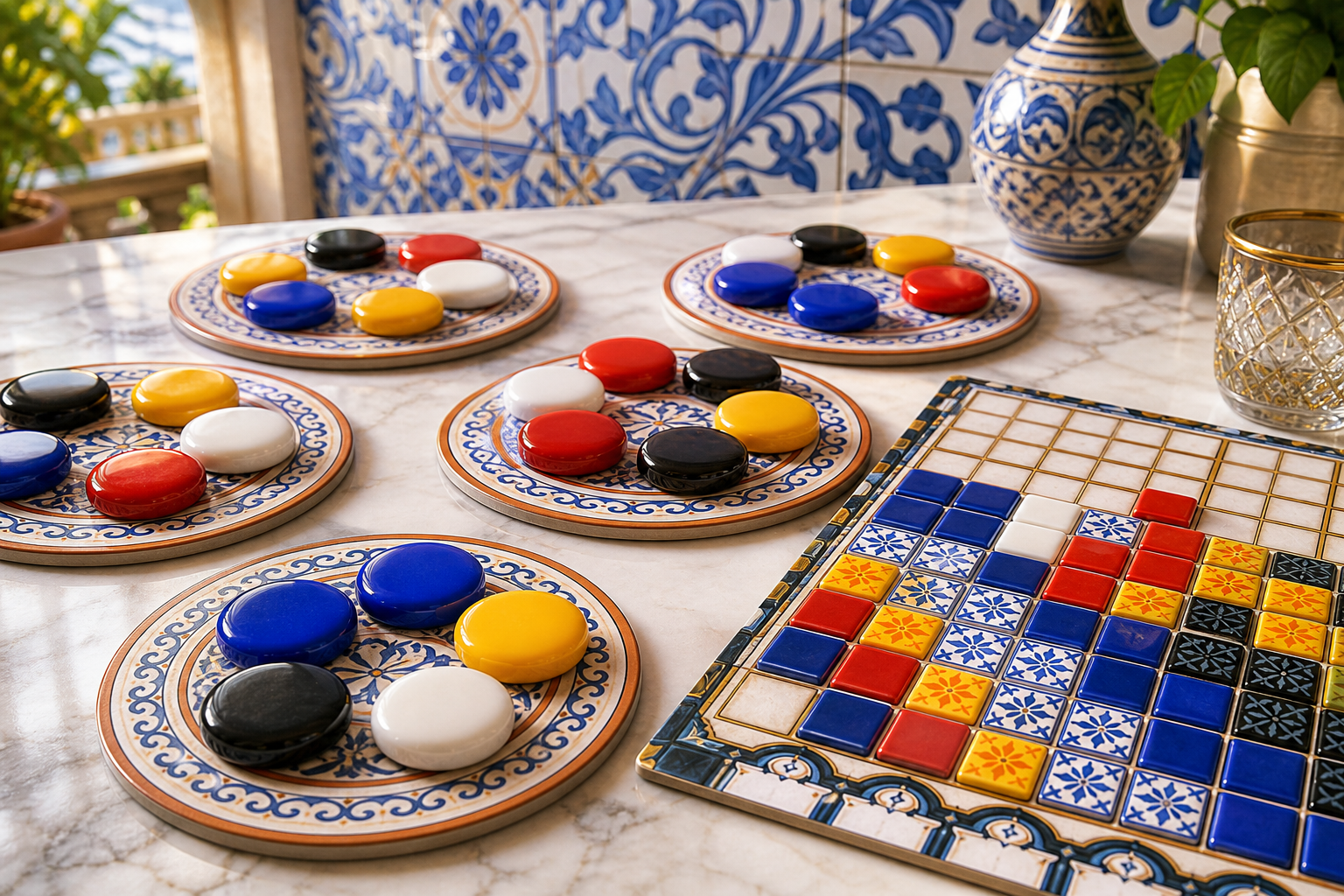
Glazed ceramic discs in cobalt, sunflower, crimson, ink, and white, sitting in circular factory trays on a blue-and-white palace table.
Origin
Azul was designed by Michael Kiesling. It is associated with Portugal-inspired; designed in Germany / published by Plan B Games. Dating: 2017.
Equipment
100 resin tiles in 5 colors, 5–9 factories, player boards with a 5×5 wall, first-player marker
Players: 2–4. Typical duration: 30–45 minutes.
Questions
When does Azul end?
At the end of a round in which at least one player has completed a horizontal row on the wall. Then apply row, column, and color bonuses.