
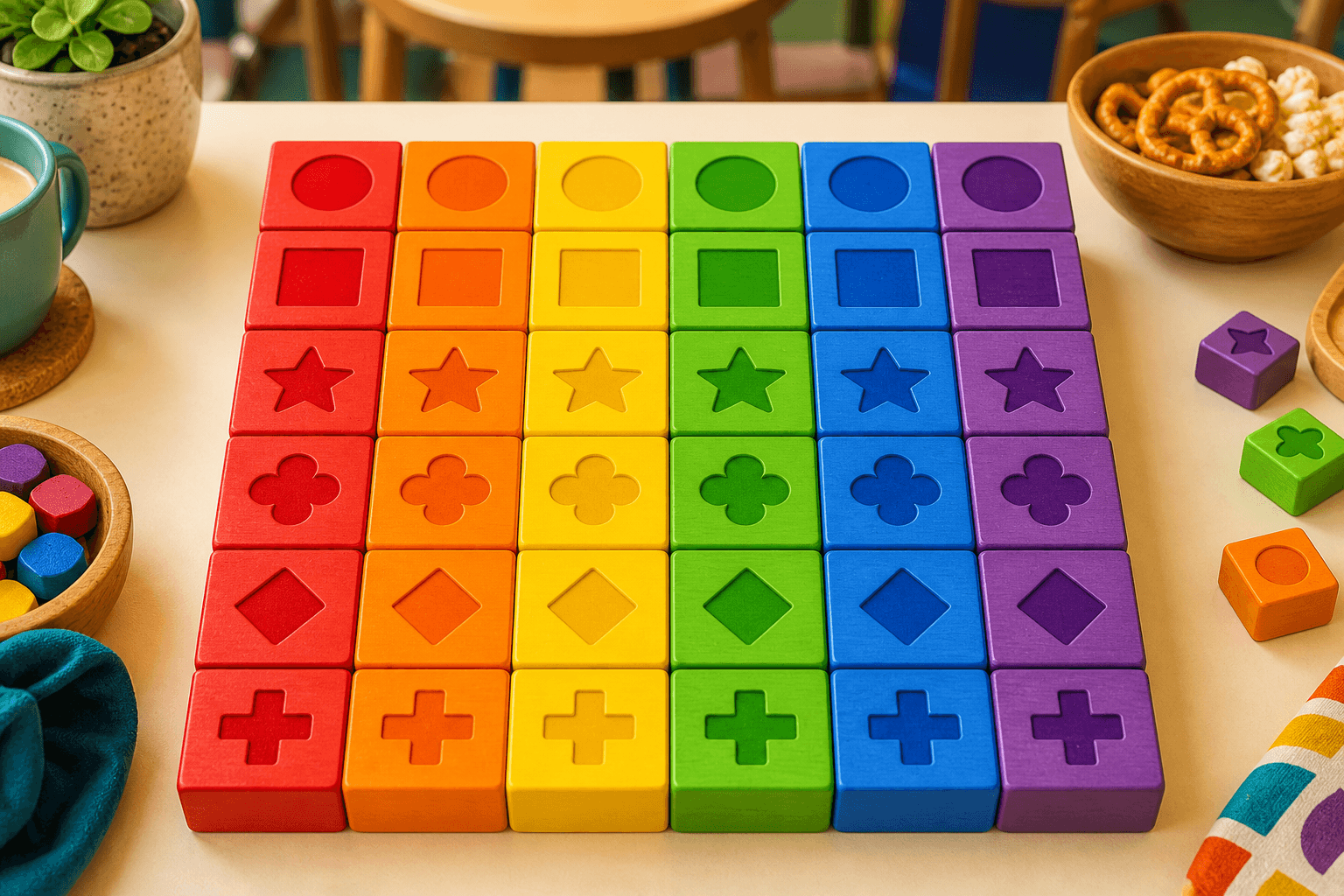
rules
Color Cubes rules
Canonical Tilehaus procedures for Color Cubes: equipment, deal, legal plays, and how the hand ends.
Placement
On a turn you place one or more cubes in a single straight line, all sharing color or shape consistently with every affected line.
Instead of placing, you may trade cubes from your rack with the bag.
Frequently asked questions
Straight answers to what people search — for Google, voice, and assistants.
How do you play Color Cubes?
Place wooden cubes so every line shares one color or one shape, with no duplicate face in that line. On a turn you play one or more cubes in a single straight line, then refill to six. Score the length of every line you extend.
How do you score a Qwirkle or six-line?
A line of six scores 6 for length plus a 6-point bonus, totaling 12. The same cube can also score a crossing line. That six-line is the commercial game’s “Qwirkle.” Tilehaus calls the table Color Cubes.
How many tiles are in Color Cubes?
108 cubes: 6 colors × 6 shapes × 3 copies. Each player holds six and refills after a play when the bag allows.
How many players is Color Cubes?
Two to four. The 2011 Spiel des Jahres winner in this color-and-shape family is a 2–4 player grid game. Tilehaus seats the same range.
When does Color Cubes end?
When the bag is empty and a player places their last cube. That player gets a 6-point finish bonus. Highest score wins.
Can you play two identical cubes in one line?
No. A legal line is all one color with different shapes, or all one shape with different colors, and at most six cubes long. Two cubes with the same color and shape cannot share a line.
Is Color Cubes the same as Qwirkle?
They are the same public rules family: 108 cubes, lines of color or shape, 12 points for a six-line. Qwirkle® is a trademark. Tilehaus is an independent table named Color Cubes.
How long does Color Cubes take?
About 30–45 minutes for 2–4 players. The grid grows slowly at first, then six-line races decide the last ten minutes.