
guide
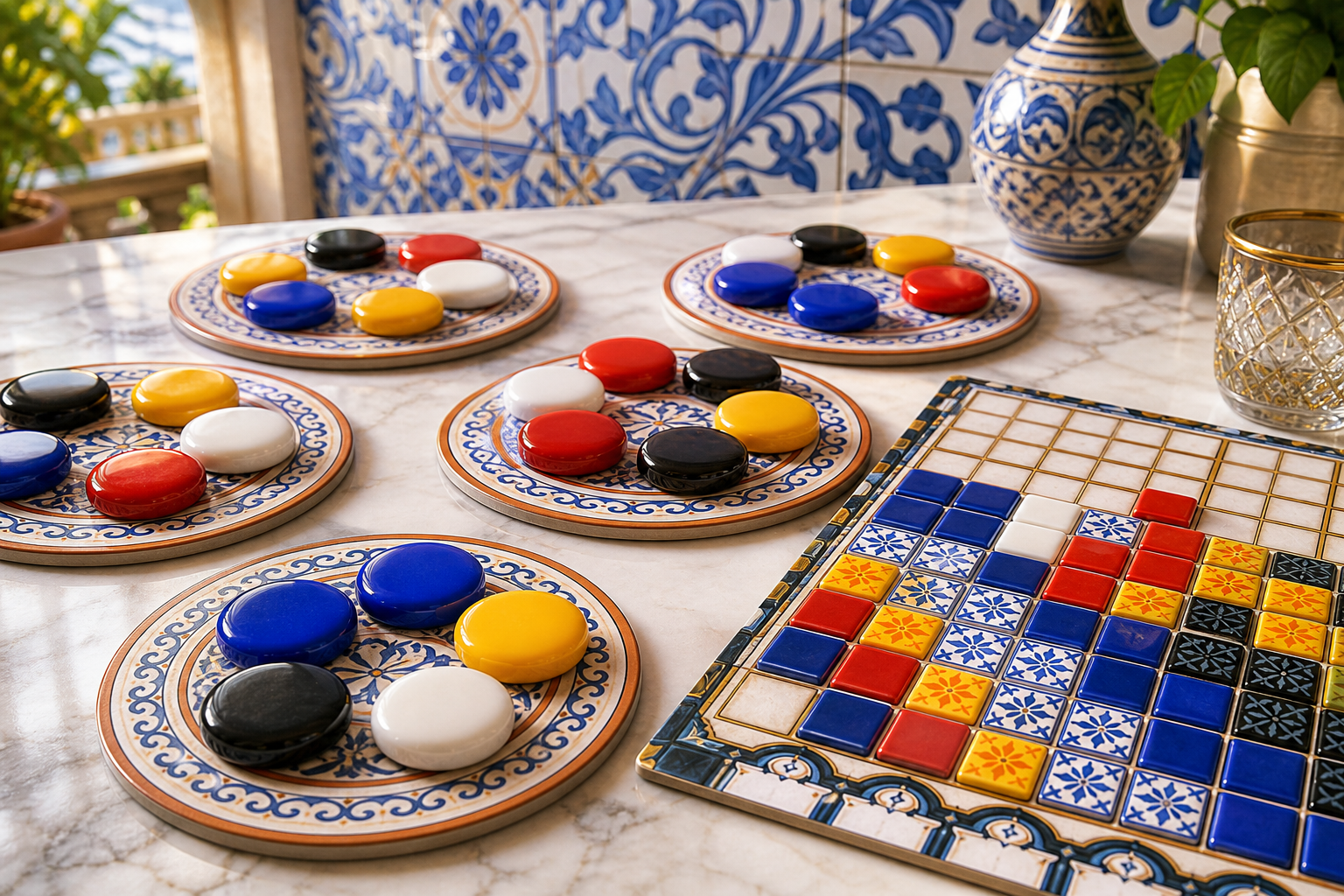
Mosaic Wall first game: factories, pattern lines, wall
How 5, 7, or 9 factories, 100 tiles, and the 5×5 wall fit together on a first play.
The only numbers you need
2 players → 5 factories. 3 → 7. 4 → 9. Each factory starts with 4 tiles. Pattern line 1 holds 1 tile; line 5 holds 5.
Frequently asked questions
Straight answers to what people search — for Google, voice, and assistants.
How do you play Mosaic Wall?
Draft all tiles of one color from a factory or the center, park them on a pattern line, then tile a 5×5 wall. Leftover factory tiles go to the center. Completing a horizontal wall row ends the game after that round’s tiling.
When does Azul or Mosaic Wall end?
After the wall-tiling phase in which at least one player has a complete horizontal row of five. Then add end-game bonuses: +2 per complete row, +7 per complete column, +10 per complete color. Highest score wins.
How does scoring work in Mosaic Wall?
When a tile moves to the wall it scores 1 if isolated, or the full length of its horizontal group plus the full length of its vertical group if it touches neighbors. Floor-line leftovers subtract 1, 1, 2, 2, 2, 3, 3. You cannot drop below 0.
How many factories are in Mosaic Wall?
Five factories for 2 players, seven for 3, nine for 4. Each factory holds four tiles. There are 100 tiles — 20 in each of five colors.
What does the first-player marker do?
Taking tiles from the center after the marker is there also takes the marker. It occupies a floor-line space (a penalty) and you start the next draft.
How many players is Mosaic Wall?
Two to four. The 2018 Spiel des Jahres factory-draft mosaic is built for that count. Two-player games use five factories and play faster.
Is Mosaic Wall the same as Azul?
Same public rules family: factories, 5×5 wall, floor penalties, row-ends-the-game. Azul® is a trademark. Tilehaus is an independent teaching table named Mosaic Wall, with azulejo-inspired art direction — not an official edition.
How long does Mosaic Wall take?
About 30–45 minutes. The shortest possible game is five rounds (one row per round); most tables run longer while players chase columns and colors.